
Factory-direct from Lahore · Nationwide delivery in 2–4 days
+92 319 4262451
WhatsApp
Inside a classroom the wiring is ordinary. What makes a campus different is the ground between the buildings — and past about 100 metres the cable stops being chosen by the load at all.
On a campus the distance picks the size, not the amps.
A block with a 35 kW after-diversity demand draws 35,000 ÷ 611 = 57.3 A at 415 V, and 16 mm² carries that with room to spare at 76 A. Put 150 metres of campus between the main board and the block and 16 mm² drops 20.63 V — twice the 10.4 V a 2.5% budget allows — and even 25 mm² fails at 12.89 V. The feeder goes to 35 mm², two sizes above what the current alone would have bought. Inside the block the wiring is ordinary: 1.5 mm² on lights and fans, 2.5 mm² on sockets.
Read the third column down the table. The input that fixes the cable changes at every layer, and only the first two are the ordinary building-wiring job.
| Supply layer | Typical run | What fixes the size |
|---|---|---|
| Classroom final circuits — fans, tube lights, sockets | A few metres | Connected load, with little diversity: a block switches on together at the first bell |
| Block distribution board and riser | Tens of metres | After-diversity demand of the block, then grouping in the riser |
| Main board to a separate block or hostel | 80 to 250 m across the site | Voltage drop, long before current |
| Laboratories, workshops and IT rooms | Within the block | The equipment schedule — benches and servers run continuously |
| Kitchen, pumps, lifts and generator plant | Plant room | Nameplate full-load current and starting behaviour |
| Crossings under drives, courts and playgrounds | The route | Burial depth and mechanical protection, not amps |
A word on row one, because it is the one most often got wrong on a school: diversity is an allowance for loads that are not all on together, and in an office they are not. A school runs to a bell. The fans and tube lights of an entire block go on within a minute of the first period and stay on until the last. Treat those circuits as close to simultaneous and keep the diversity for the laboratories and the kitchen — the method is on commercial load calculation.
The hostel block's board has a 35 kW after-diversity demand. The feeder leaves the main board and runs 150 m on tray through the corridor link between the two buildings.
Two levers are worth more than a size of cable on a run like this. Moving the block's board closer to the load shortens the feeder. Choosing the drop budget deliberately — 2.5% on a feeder, or the looser 5% where the design allows it — changes the answer more than anything else on the drawing, so write the figure you used on it. If the feeder goes in the ground instead of on tray, burial is a different installation method with its own ratings: see cable for an underground run. Check your own length in the voltage drop calculator, and the general reach of each size on 3-phase cable size.
Class 2 copper for classroom circuits, block risers and feeders.
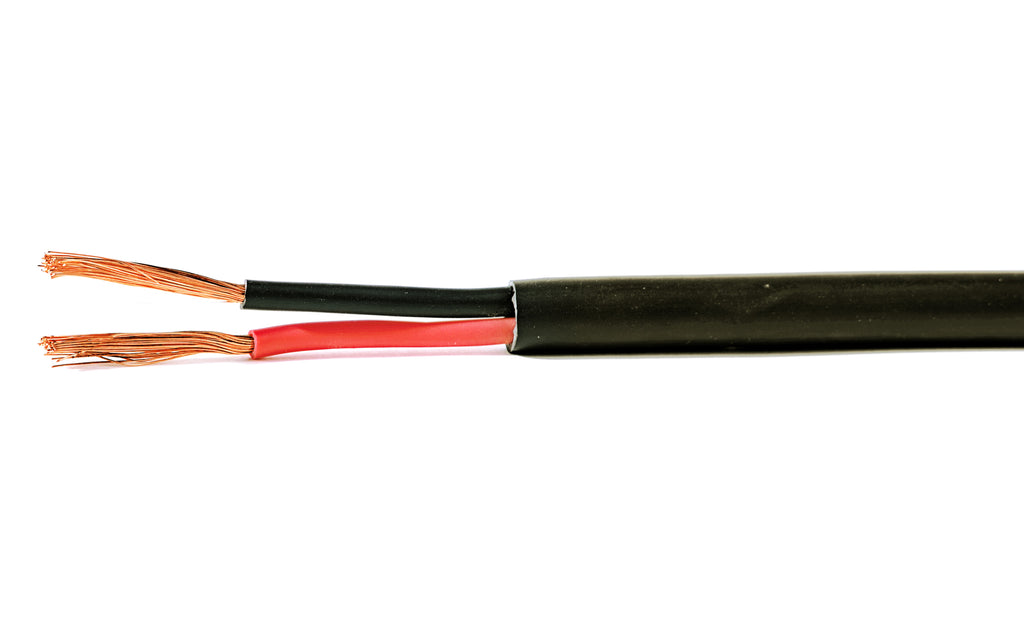
Class 5 copper for lab bench tails and equipment leads.
Classroom wiring is fixed and chased, so it is class 2 stranded copper, PVC insulated, 450/750 V — 1.5 mm² on the fan and light circuits, 2.5 mm² on sockets. A staff room or hall air conditioner takes a dedicated circuit of its own, which at 1.5 ton is 4mm 3 core cable on a 20 A breaker; the working is on the 1.5 ton AC wire size guide. Laboratory bench tails and portable equipment leads are the one place class 5 flexible belongs.
One limit, stated before you order rather than after: our line is PVC insulated copper and aluminium at a 70 °C conductor rating, 450/750 V fixed and 300/500 V flexible. It is not fire-survival or low-smoke cable, which is a separate certified product class — our position on that is on fire resistant cable. Send the specification with the enquiry and we will say which lines of it our range covers.
Size, cores, construction and metres per line — or the load schedule, and we will read the sizes off it with you.
Cable is priced off the day's copper rate, so the quote carries its date. No dealer margin between the line that drew it and you.
Collect from the factory in Lahore, or we dispatch — Punjab in 1–2 days, rest of Pakistan in 2–4 days.
Send the load schedule or the cable lines from the BOQ. You get the day's factory price against each one, with collection from Lahore or delivery nationwide.