Factory-direct from Lahore · Nationwide delivery in 2–4 days
+92 319 4262451
WhatsApp
A mill floor is a bank of identical motors. That single fact changes the sizing: circuits arrive at the sub-board eight and ten at a time in one tray, on a floor that never sees 30 °C.
In a mill it is the tray, not the run length, that picks the size.
A spinning sub-board carrying 45 kW draws 45,000 ÷ 611 = 73.6 A at 415 V. With eight loaded circuits in the same tray on a floor near 40 °C, take the ambient and grouping factors as multiplying to 0.65: the cable now has to be tabulated for 73.6 ÷ 0.65 = 113 A, which puts 25 mm² at 96 A out and lands the feeder on 35 mm². The tails onto the machines themselves are a different product — class 5 flexible, because they get unplugged and re-dressed every time the layout moves.
Motor count, heat and lint are what separate a mill from an ordinary plant. Read the third column: on most of these rows the deciding number is a correction factor, not a load.
| Mill area | What runs there | What fixes the cable |
|---|---|---|
| Blowroom and carding | Large motors, heavy lint fall | A route that can be cleaned, and the grouping factor in the tray |
| Ring spinning and simplex | Banks of identical motors on one sub-board | Grouping — eight or ten loaded circuits sharing a tray |
| Weaving shed | Dense loom count, machines moved between layouts | Class 5 flexible tails that survive being re-dressed |
| Dyeing and finishing | Steam, wash-down, standing heat | A route clear of wet plant, and protection where it cannot be |
| Compressor and humidification plant | Continuous duty in a closed plant room | Ambient correction — the hottest point on the site |
| Incomer, transformer yard to shed | One long run, 100 m and up | Voltage drop, not current |
| Earth and bonding | Machine frames, tray and panel bonding | Derived from the phase conductor it protects |
The kW-to-mm² ladder behind row two is on 3-phase cable size; a single motor with its nameplate current and starting behaviour is worked on industrial cable sizing. The last row is derived rather than guessed — the derivation is on earth cable.
The board carries 45 kW of machine load, sits 70 m from the main panel, and its feeder shares a tray with the machine circuits it serves on a floor that runs near 40 °C.
So the feeder is 35 mm² four core — two sizes above what the 30 °C chart alone would have sold, and the whole difference is the correction. Write it as base × factor = result so the next person can audit it, and check your own run in the voltage drop calculator.
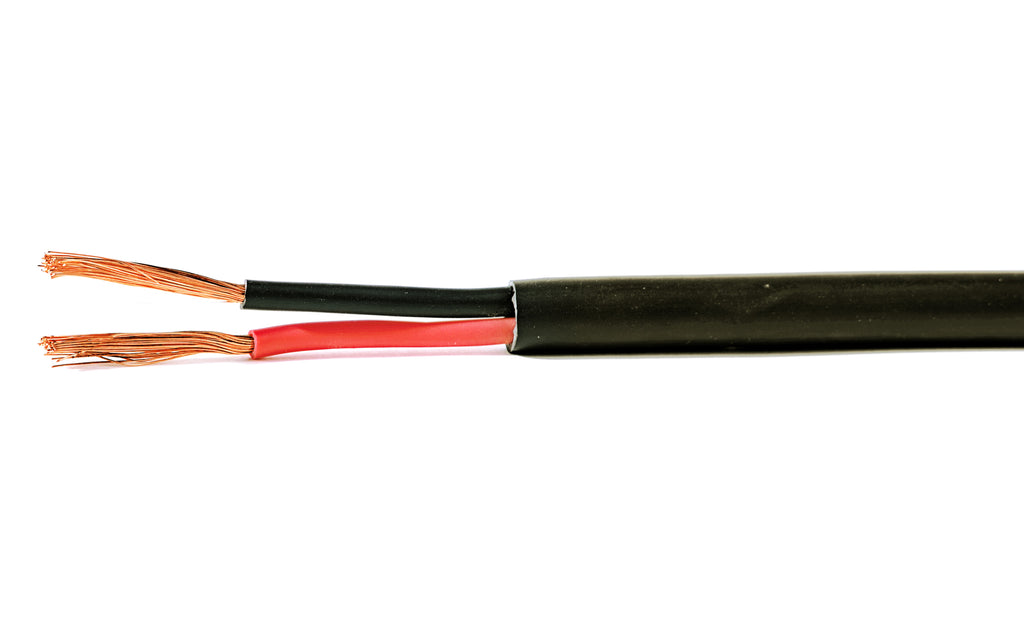
Class 5 copper for tails and control panel connections that get moved.
Class 2 copper for panel-to-board and board-to-machine runs on tray.
A 5.5 kW loom motor draws 5,500 ÷ 611 = 9.0 A, and 1.5 mm² carries that on paper at 17.5 A. It is still the wrong cable. A tail that is unplugged, dragged and re-dressed every time a layout changes is decided by the terminal and the handling as much as by the current, which is why mill tails run heavier and in class 5 — 4mm 3 core flexible cable is a common size for a mill tail. The fixed feeder behind it stays class 2, PVC, 450/750 V.
One limit, stated before you order rather than after: our line is PVC insulated copper and aluminium at a 70 °C conductor rating, 450/750 V fixed and 300/500 V flexible. It is not medium-voltage cable, and it is not fire-survival or low-smoke cable, which is a separate certified product class — our position is on fire resistant cable. Send the specification with the enquiry and we will say which lines of it our range covers.
Size, cores, construction and metres per line — or the machine schedule, and we will read the sizes off it with you.
Cable is priced off the day's copper rate, so the quote carries its date. No dealer margin between the line that drew it and you.
Collect from the factory in Lahore, or we dispatch — Punjab in 1–2 days, rest of Pakistan in 2–4 days.
Send the machine schedule or the cable lines from the BOQ. You get the day's factory price against each one, with collection from Lahore or delivery nationwide.